(303) 420-8242 | 7333 W. Jefferson Ave., Suite 235, Lakewood, CO 80235 USA

C&IH utilizes an assortment of modeling technologies to characterize workplace and community exposures.
One such modeling tool is computational fluid dynamics (CFD), a three-dimensional computer modeling technology that simulates an airborne contaminant’s distribution under site-specific and client-selectable conditions.
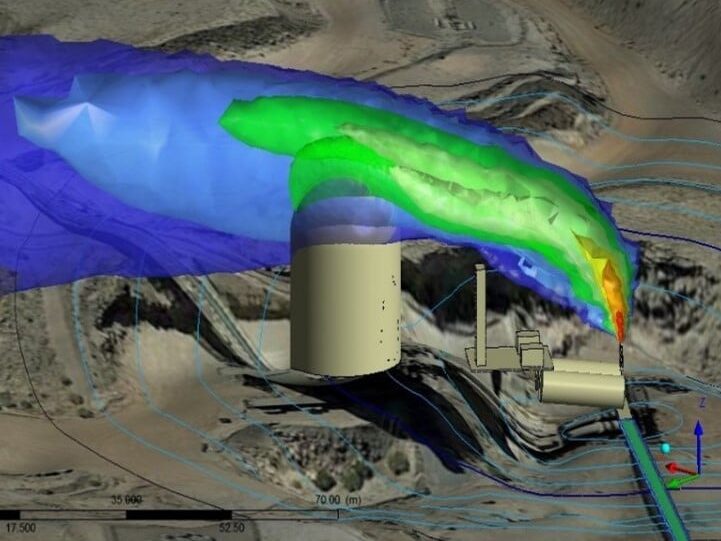
C&IH applies computational fluid dynamics to create models for predicting how a gaseous or airborne particle contaminant will disperse under specified variable conditions. Examples of variable conditions that can act as model parameters include air velocity, pressure, temperature, and humidity. Contaminant properties can also be specified including particle size, chemical composition, and density. In the performance of an exposure assessment, these variable inputs enable CFD to be used as a valuable tool for airborne contaminant characterization and dispersion modeling; specifically, to test, replicate, or predict a contaminant’s transport, distribution and pathway.
Airflow modeling using CFD creates an effective visual validation tool for communicating and managing occupational health exposures. Examples include:
Validate existing air sampling data of indoor or outdoor air contaminant emissions including gases, fibers, and particles
Generate exposure modeling data when air sampling is not possible or has limitations
Model contaminant dispersion characteristics of historical job-sites and workplace activities (when air monitoring is no longer possible) to understand past exposure
Characterize community exposures through plume modeling of outdoor contaminant dispersion

In addition to CFD’s role in supporting exposure assessment projects, the air flow modeling capabilities of CFD also serve as a valuable tool in the design and validation of engineering controls. Examples include:

Air flow modeling using computational fluid dynamics can be a valuable tool in support of various industrial hygiene related projects. C&IH’s exposure modeling team includes certified industrial hygienists that are also certified as professional simulation engineers (PSE) by NAFEMS for demonstrated competency in computational fluid dynamics. Our team has worked with clients across multiple industries and collaborates with each client to define specific goals and criteria for every CFD model. C&IH can also incorporate historical data sets with on-site measurements or collect new field data to validate models generated. Specific aspects of on-site activities may include air monitoring, evaluation of indoor/outdoor spaces, air exchange rates, spatial anomalies, source concentration and generation rate, distances from source contaminant, and inspection of ventilation schematics and design.

C&IH provides national and international consulting from our office located near Denver, Colorado.